About the Laboratory
The Austrian metal industry, one of the country´s most important economic pillars, faces pressing issues that will shape the future of innovation and competitiveness. The most urgent challenges facing today´s industry require optimising production efficiency and minimising waste, energy consumption, and environmental impact.
Metallurgical processes are based on the controlled application of heat to melt or solidify materials. During these phase transitions, chemical reactions play an important role in purifying and refining the materials to ensure that the end products meet the required specifications and quality standards. A key challenge in the metallurgical industry has therefore always been the accurate prediction and control of mass transport and chemical conversions. Additionally, capturing the complexity of metallurgical processes requires integrating mass transfer and chemical reactions with phenomena such as turbulent flows in molten slag and metal, solidification and melting, gas evolution, as well as plasma generation and expansion. This CD Laboratory will thoroughly investigate these processes using advanced numerical methods.
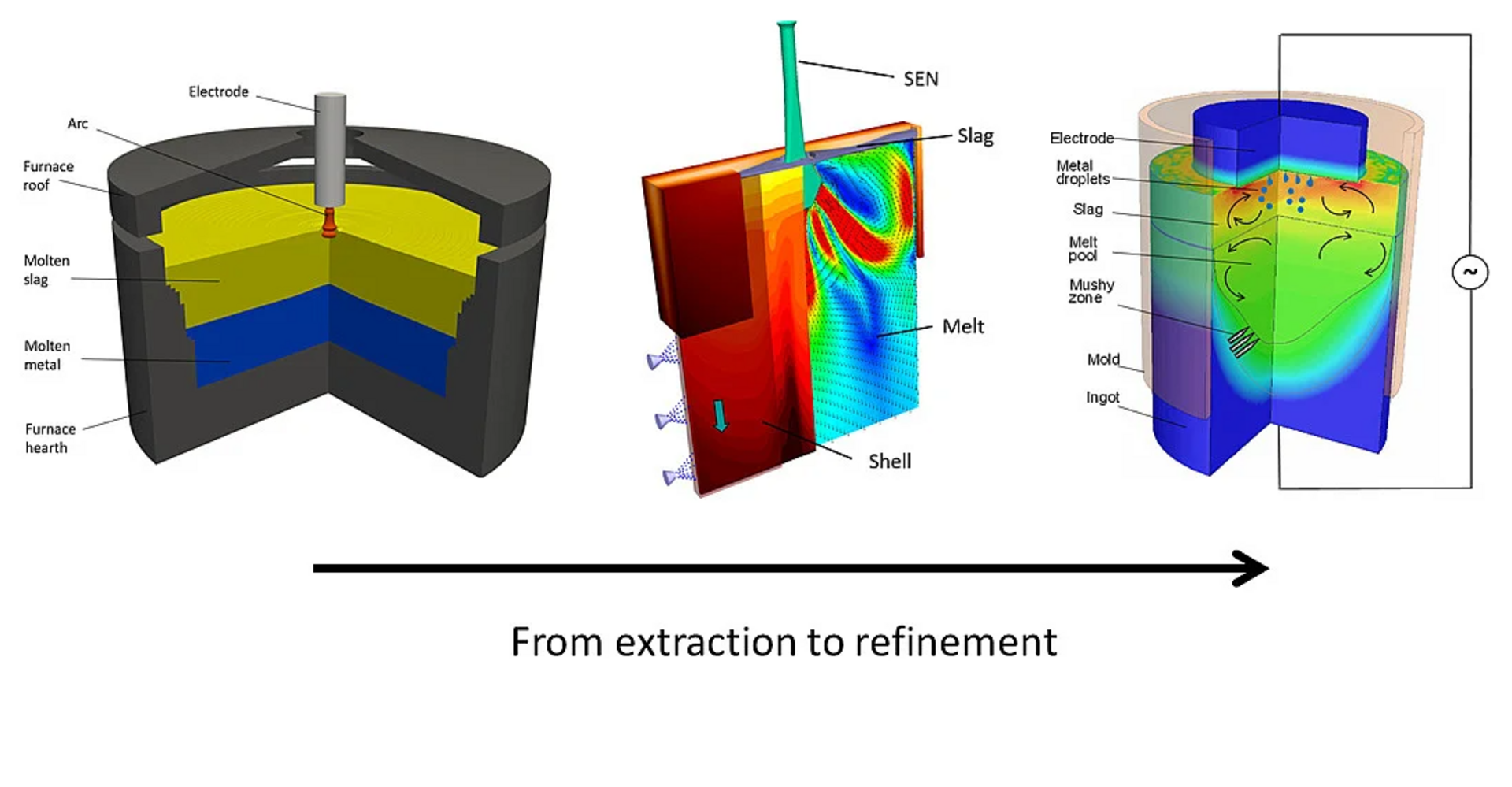
Considering industrial application, this CD Laboratory focuses on critical phases of clean steel production and refining, starting with extraction and production by electric arc furnace (EAF), advancing through continuous casting to refining by electroslag remelting. The electric arc furnace is the most important process for the transition to the so-called green steel. Many fundamental questions of process technology still need to be clarified, which are the focus of this CD Laboratory.
This includes research into the optimisation of chemical reactions and process efficiency within the electric arc furnace, which are crucial for product purity. The role of CO-induced foam formation in the slag in the thermal insulation of the furnace is also being investigated. In addition, the effects of electrode erosion on arc stability, process operation, and the risk of defects in the final steel product are being investigated. Another key focus is the replacement of carbon with hydrogen, as this releases water instead of CO2 as an exhaust gas, aiming to mitigate environmental impacts. Understanding the reaction rates and slag chemistry under these conditions is crucial.
Another aspect of the research is chemical reactions and quality control in continuous casting. This focuses on investigating the complex interactions within the slag band, which consists of the powder layer, the sinter layer, and the liquid slag. The aim is to improve slag protection and overcome challenges such as reoxidation of the melt surface and the formation of inclusions. This should ensure high steel purity and increased production efficiency in the continuous casting process.
The third research aspect focuses on cleaning and stable operation in electroslag refining. This concentrates on the critical mass transfer phenomena that occur at the slag-metal-mould-air interfaces in the electroslag remelting process. In addition, the melting behaviour of the electrode during remelting is being optimised to ensure stable process operation. Scale-up effects during the transition from laboratory to large-scale electroslag remelting are also being investigated.

Mass transfer in continuous casting involves turbulent melt flow, slag, gas bubbles, non-metallic inclusions (NMIs), and interfacial reactions under external forces. © CD Laboratory for Reactive Flows in Green Steel Production and Refinement

Simulated arc plasma jet impinging on molten steel illustrates arc-melt interaction and surface behavior. © CD Laboratory for Reactive Flows in Green Steel Production and Refinement
Commercial Partners
The laboratory brings together leading industrial partners with extensive expertise in metallurgy, process engineering, and steel production. This multidisciplinary collaboration provides a strong foundation for developing innovative technologies that advance green steel production, improve resource and energy efficiency, and reduce the environmental footprint of metallurgical processes. By combining fundamental research with industrial experience, the laboratory accelerates the transfer of scientific innovations into practical applications, supporting the transition toward a more sustainable and climate-neutral steel industry.
RHI Magnesita GmbH – Global leader in refractory materials and solutions for high-temperature industrial processes, providing expertise in refractory performance and industrial implementation.
Primetals Technologies Austria GmbH – International engineering company for metallurgical plants and process technologies, supporting process development, scale-up, and industrial integration.
INTECO– Global technology provider specializing in the design and engineering of metallurgical plants and equipment, contributing industrial expertise, process innovation, and advanced solutions for sustainable steel production and refining technologies.
News & Updates
A new CD-Laboratory @ SMMP
27 Jan. 2026 - Inauguration of the new CD Laboratory for Reactive Flows in Green Steel Production and Refinement

“The Technical University of Leoben has opened the new Christian Doppler Laboratory for Reactive Flows in the Production and Refinement of Green Steel. The laboratory is based at the Chair of Simulation of Metallurgical Processes, is funded by the Federal Ministry for Economic Affairs, Energy and Tourism (BMWET), and strengthens the university’s strategic focus on circular engineering. It exemplifies the close integration of top-level academic research with leading industrial partners in the spirit of the Christian Doppler Research Association.”
Contact
Montanuniversität Leoben
Chair of Simulation and Modeling of Metallurgical Processes
Franz-Josef-Straße 18/III, 8700 Leoben, Austria
Tel.: 0043 3842 4023115
Email - Head of Lab: ebrahim.karimi-sibaki(at)unileoben.ac.at
Email - Head of Chair: abdellah.kharicha(at)unileoben.ac.at
Homepage: https://smmp.unileoben.ac.at/labs/christian-doppler-laboratory
© 2026 CD Laboratory for Reactive Flows in Green Steel Production and Refinement