About the Laboratory
In metallurgy, many new processes are currently introduced through trial and error due to an insufficient understanding of the underlying process phenomena. This Laboratory seeks to systematically close these knowledge gaps and thereby enable fundamental innovation.
In industrial processes, particularly in the metallurgical industry, the application of electromagnetic fields is widespread. The interaction between the involved fluids—metallic melts, molten salts, plasmas, and electrolyte solutions—and electromagnetic fields gives rise to the so-called Lorentz force and to electromagnetic induction. The comprehensive description of these interactions is referred to as magnetohydrodynamics (MHD). A detailed understanding of the MHD of a metallurgical process enables direct control and manipulation of phenomena occurring within the process. Important examples include inductive melting, stirring and pumping, stabilization of melts, free surfaces and interfaces, as well as magnetic levitation, i.e., the contactless suspension of electrically conductive fluids.
Despite its importance, new MHD-based equipment and technologies are still frequently introduced in industry on the basis of costly experimental trials due to a lack of quantitative understanding. In other words, processes are often developed according to a trial-and-error approach, progressing from laboratory experiments to pilot-scale testing and finally to implementation in industrial production.
This Laboratory aims to scientifically describe selected metallurgical processes and thereby provide a structured basis for their optimization. MHD technologies are already routinely applied in the Austrian metallurgical industry. However, further innovation is only possible if these technologies are understood in greater scientific depth and if seemingly contradictory experimental observations can be explained and systematically controlled.
The research focuses on the modeling of electromagnetic braking in thin-slab casting, MHD-based metal refining, and the MHD of electric arc furnaces. To achieve this, advanced computational methods are coupled with the physical description of solidification and magnetohydrodynamics. Existing numerical approaches are further developed and adapted to the requirements of the corresponding industrial processes.

Instabilities in the electrolysis Hall–Héroult process. A liquid metal jet is generated when a sufficiently strong electric current is passed through the bath/liquid aluminium interface. The electromagnetic pinch instability breaks the jet into small droplets. © LMA-MHD

3D simulation of the MHD in the Electro-Slag Remelting process. ESR process uses strong currents to remelt metallic electrodes. The Lorentz force pushes the slag and the metallic faucets towards the centre. © LMA-MHD

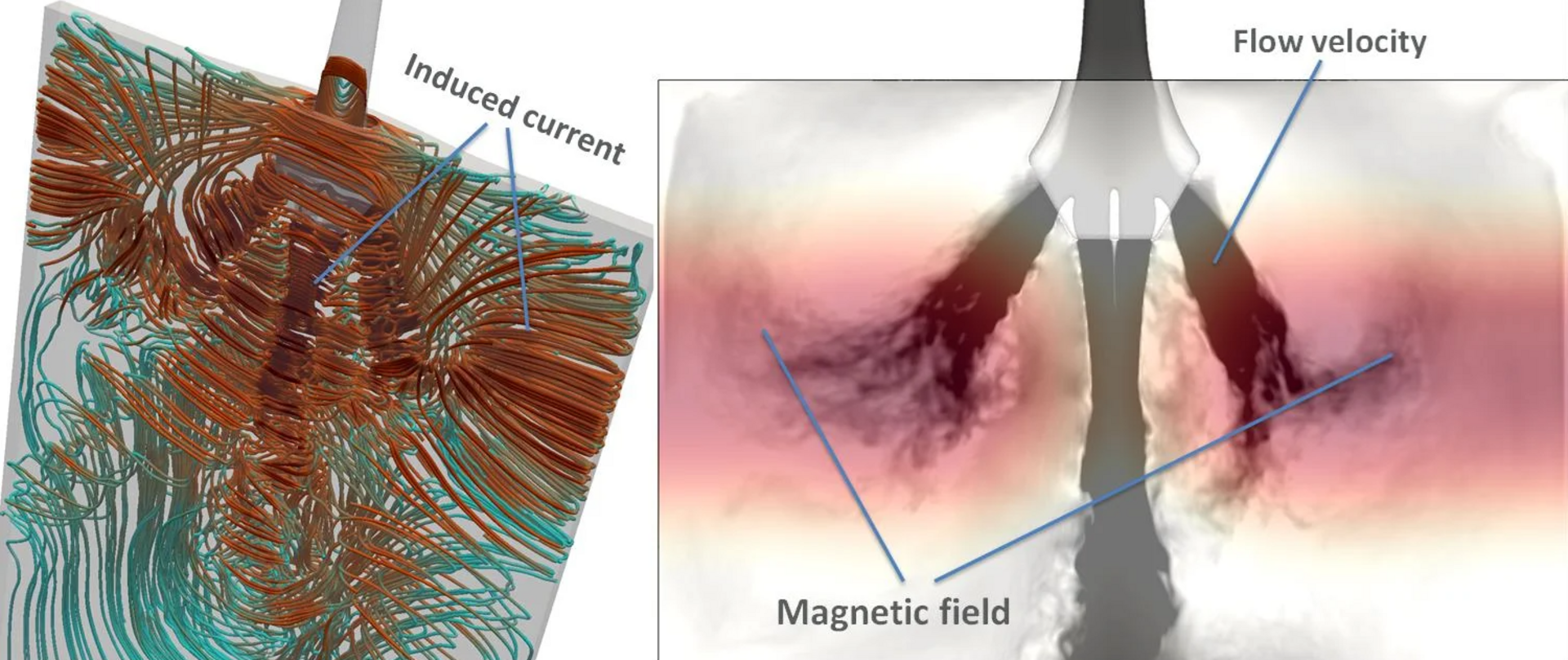
3D simulation of an electro-vortex flow. An electro-vortex forms when a strong electric current is passed through an electrode immersed in an electrically conducting liquid. © LMA-MHD
Commercial Partners
The laboratory brings together leading industrial partners and research groups with extensive expertise in metallurgy, process engineering, magnetohydrodynamics (MHD), and steel production. Building on the scientific foundation established through the former CD Laboratory, it focuses on advancing the fundamental understanding, modeling, and industrial application of MHD phenomena in metallurgical processes. The multidisciplinary collaboration provides a strong basis for investigating the interaction between electromagnetic fields and electrically conductive fluids, with applications including electromagnetic stirring and braking, melt flow control, refining, and process optimization. By combining fundamental research, advanced numerical modeling, and industrial experience, the laboratory supports the development of innovative MHD-based technologies, improves resource and energy efficiency, and facilitates the transfer of scientific findings into industrial applications. In this way, the laboratory contributes to the development of more efficient, sustainable, and climate-neutral metallurgical processes.
RHI Magnesita GmbH – Global leader in refractory materials and solutions for high-temperature industrial processes, providing expertise in refractory performance and industrial implementation.
Primetals Technologies Austria GmbH – International engineering company for metallurgical plants and process technologies, supporting process development, scale-up, and industrial integration.
INTECO– Global technology provider specializing in the design and engineering of metallurgical plants and equipment, contributing industrial expertise, process innovation, and advanced solutions for sustainable steel production and refining technologies.
News & Updates
Ukrainian Scientists in CDG Research Units
02 Aug. 2022 - Interview with Anastasia Kadylnykova
After briefly introducing the three young Ukrainian scientists that received the CDG crisis support to work in CDG research units for 12 months before, we will now conduct interviews with each of them throughout August: Today Anastasia Kadylnykova talks with us about her research at Abdellah Kharicha's CD Laboratory at Montanuniversität Leoben.
CDG: What are you researching at the moment?
Kadylnykova: Currently, my work deals with researching the interfacial tensions at the electrolyte-metal interface, as well as the dynamic changes occurring due to chemical reactions, which in turn depend on the kinetics of the reactions at the interface, are important. When modelling the electrolyte-metal system, it is necessary to deepen the knowledge of the interfacial properties in order to calculate the similarity criteria between the model fluids and the real system. Modelling will help to better understand this phenomenon and improve scientific knowledge.
CDG: What are your next scientific goals?
Kadylnykova: Development of optimal modes of the electroslag process for producing complex alloys with improved properties-perspective of traditional ESR [note: "Electro-Slag Remelting"]. Improvement of the ESR process, which now is one of the leading for heavy parts manufacturing, will serve to raise and sustain the industrial competitiveness of Austria's heavy machinery in the line of the plan for a European industrial renaissance.
CDG: What do you particularly appreciate about the funding model of CD Laboratories?
Kadylnykova: The war changed my life. Coming to Austria was a new and challenging experience. I must admit that working in CD Laboratory became a fundamental point for me to pursue my career aim. I work with successful people and develop myself every day, with more and more my professional skills increasing. Moreover, I work in an international group, and the exchange of ideas among researchers from different countries generates a new look at the problem and new knowledge, and our joint experiments will combine their efforts to solve the scientific problems.
Significant Exchange of Knowledge between Science and Industry
28 Feb. 2024 - Head of Laboratory Abdellah Kharicha was appointed Professor in late 2023: We take the opportunity for a short interview.
CDG: Congratulations on your professorship! Do you think your work as Head of a CD Laboratory played a role in the decision in your favour?
Kharicha: Thank you very much! The establishment of the laboratory played a crucial role and provided me with the platform to build a successful research group.
This collaborative environment has not only allowed me to investigate a variety of scientific questions, but has also expanded the scope of my research beyond what I could have achieved alone.
This work has been widely recognized and appreciated by both the academic and industrial communities.
The CD Laboratory has not only accelerated my career path, but also strengthened my professional profile on an international level.
CDG: How does the CD Laboratory, which you have been heading for a good five years at this point, fit into your new role in terms of content?
Kharicha: My laboratory focuses on the use of electromagnetic fields in various applications in the manipulation and control of liquid metals, electrolytes and plasma.
This is a very broad topic. For example, we can manipulate flow patterns in metal casting to reduce errors.
Our findings in the field of high-intensity arc modeling have paved the way for the transition from coal combustion to processes based on electricity and hydrogen, which are not only environmentally friendly but also contribute to a more sustainable and efficient metallurgical industry.
CDG: What do you particularly appreciate about the CD Laboratory funding model?
Kharicha: I particularly appreciated the significant exchange of knowledge between science and industry.
My colleagues and I gained insights into the real-world challenges facing the industry, while industry partners benefited from our latest theoretical advances.
These successes have led to further investments from international industry and collaborations with renowned academic groups.
In my case, setting up a CD Laboratory created a virtuous and positive circle of continued support for research initiatives.
Contact
Montanuniversität Leoben
Chair of Simulation and Modeling of Metallurgical Processes
Franz-Josef-Straße 18/III, 8700 Leoben, Austria
Tel.: 0043 3842 4023100
Email: abdellah.kharicha@unileoben.ac.at
Homepage: smmp.unileoben.ac.at/labs/laboratory-for-metallurgical-applications-of-magnetohydrodynamics
© 2026 Laboratory for Metallurgical Applications of Magnetohydrodynamics